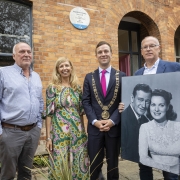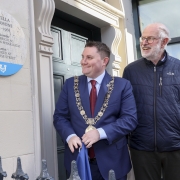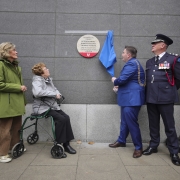
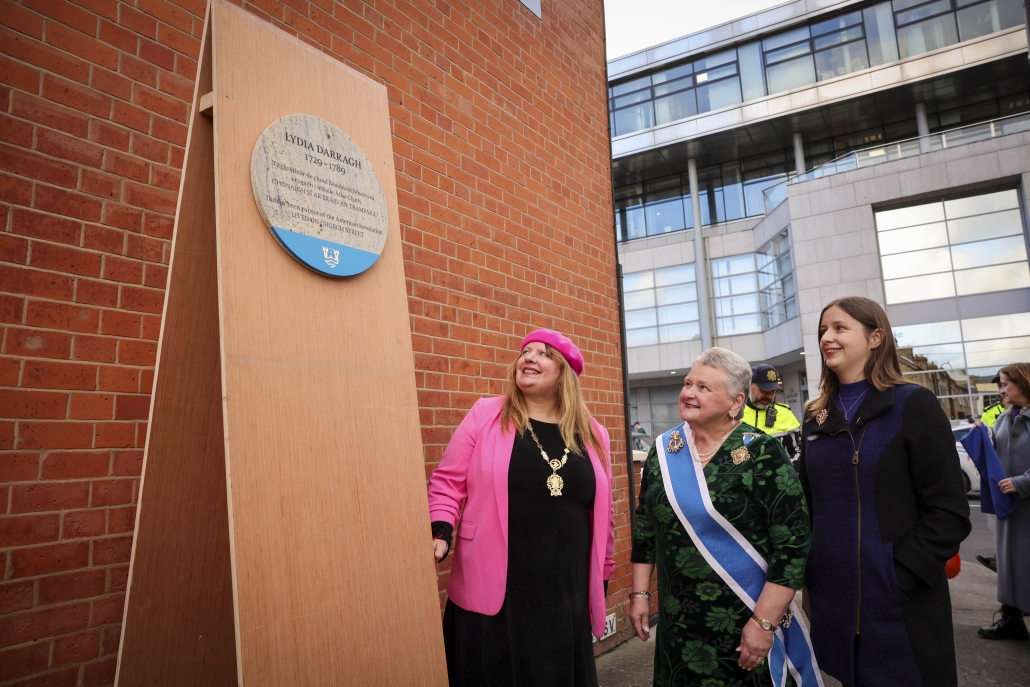
Commemorative Plaque Honouring Dublin-born patriot of the American Revolution Lydia Darragh unveiled
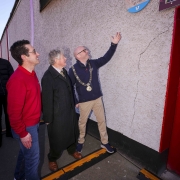
Dublin City Council today unveiled a commemorative plaque honouring Lydia Darragh, a Dublin-born woman remembered for her role in the American Revolution and her contribution to American history.
The plaque was unveiled on Church Avenue, Church 7, recognising Darragh’s connection to the area where she lived with her family before emigrating to Philadelphia in 1765. The unveiling celebrates the life and legacy of a remarkable woman whose story highlights the longstanding historical connections between Ireland and the United States.
Councillor Donna Cooney, deputising for the Lord Mayor of Dublin, said, “Lydia Darragh’s story reminds us of the courage and conviction of Dublin women whose influence reached far beyond our city. A pacifist who stood for peace, she is remembered for acting on her beliefs during a defining period in American history. It is fitting that we honour her here in Dublin, while recognising the connections her story represents on both sides of the Atlantic.
“Today’s unveiling marks the 80th plaque under the scheme and the 18th honouring a woman. It is heartening to see more women recognised, but there is still work to do to ensure their stories are visible in Dublin’s public life. I encourage people to nominate women whose contributions deserve to be remembered and celebrated.”
Born in Dublin around 1729, Lydia Darragh (née Barrington) was the daughter of John Barrington, a weaver and clothier in the Earl of Meath’s Liberty, and Mary Aldridge. She was raised within Dublin’s Quaker community and married William Darragh, a Dublin merchant, at the Quaker Meeting House in Sycamore Alley in November 1753.
The couple lived on Church Street, in the parish of St Michan’s, where they raised their family. Historical records from 1759 and 1760 confirm that the family had a dwelling house, warehouse and stables on the street.
In 1765, Darragh and her family emigrated to Philadelphia, where she worked making burial garments and preparing the deceased for burial. She later became known for her reported role in supporting American forces during the Revolutionary War.
According to an account first published in 1827, during the British occupation of Philadelphia in December 1777, Darragh overheard British officers planning an attack on General George Washington’s army. She reportedly carried a warning to American forces, allowing them to prepare for the planned advance.
Her actions have since been recognised by the Daughters of the American Revolution, who honour her as a patriot of the American Revolution.
Darragh died in Philadelphia in December 1789, leaving behind a legacy that continues to be remembered more than two centuries later.
Although the original buildings associated with the Darragh family no longer survive and the precise location of their home is unknown, 40 Church Avenue was identified as the closest practical location for the commemorative plaque.
The plaque forms part of Dublin City Council’s Commemorative Plaques Scheme, which recognises individuals and events that have made significant contributions to the history and life of Dublin.
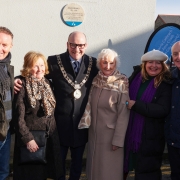
The event was also addressed by Mrs Ginnie Sebastian Storage, President General, National Society Daughters of the American Revolution. Over 130 delegates of Daughters of the American Revolution, visiting from the US attended the ceremony.
For further information on the scheme, visit www.plaquesofdublin.ie.